
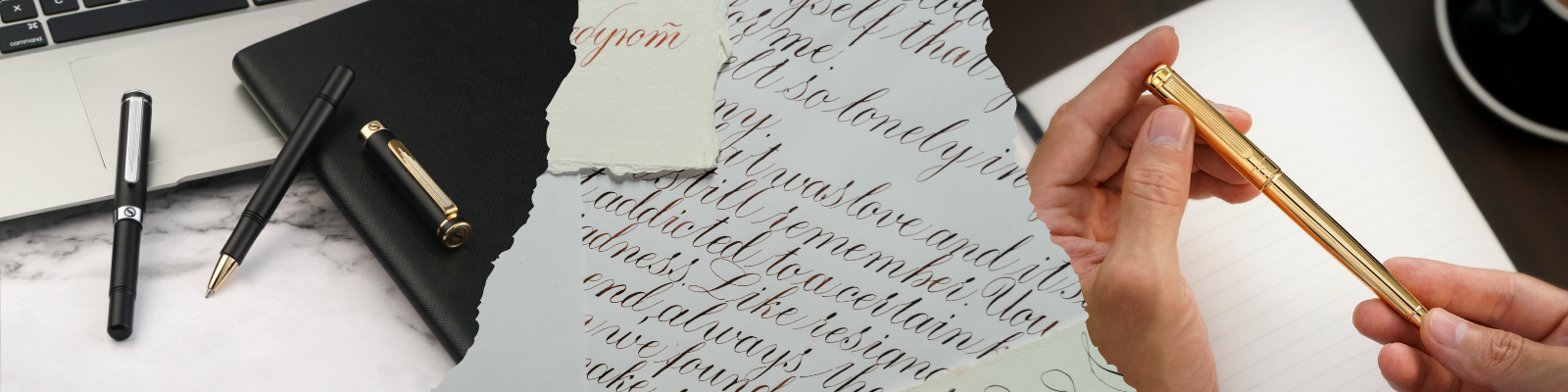
Why Should We Write More by Hand in 2026?
The year 2026 continues the discussion around AI. Whether it is bad, good, or neutral; whether it destroys jobs or creates them; whether it is here to stay or yet another bubble waiting to burst. Whatever we believe, one thing is difficult to deny: AI-produced content is appearing more often, and will continue to do so.
AI has made it remarkably easy to create almost anything. You can write an essay in minutes, draft a marketing strategy, or generate an image of a cat holding a pen. For users, this means that creators who were once limited by time or skill now have tools that allow them to produce more. Some of this output will be extraordinary, some quite good, some entirely forgettable. But one thing is certain: the amount of content we are expected to engage with is growing exponentially.
Our minds were never designed for this volume of information. Numerous studies, for example, this meta-analysis of 71 publications, show that constant exposure to content, whether produced by humans or machines, places a sustained strain on our cognitive abilities. This is one of the reasons many people have stepped away from social media altogether.
Where It Began
The term doomscrolling entered everyday language in 2020, during the pandemic, when many of us found ourselves consuming news endlessly. We moved rapidly from source to source, scrolled through short-form videos, read expert commentary, and listened to podcasts, often all within the same hour.
The pandemic was unprecedented in its scale and uncertainty. For many, it divided life into a clear “before” and “after”. In an attempt to manage anxiety and unpredictability, we consumed more information, which in turn created demand for even more content to be produced.
The pandemic may be behind us, but the habit remains. There are always global events we feel compelled to follow, issues we believe we must understand in full. Otherwise (and there is rarely a clear conclusion to that “otherwise”), we feel uneasy. That discomfort is often eased by further scrolling.
How It Unfolds: The Rise of Analogue Life
In the second half of 2025, Michaels, the arts and crafts retailer operating over 1,300 stores across North America, observed a notable shift: searches for “analogue hobbies” on their website increased by 136%.

Above: A recent study conducted by the Financial Times and GWI suggests that people in developed markets now spend an average of two hours and twenty minutes per day on social media. Which is almost 10% less than in 2022, when usage reached its peak.
The popularity of so-called “analogue bags” reflects the same movement. People are assembling collections of objects tied to specific offline activities, whether its isreading, playing an instrument, or learning a craft, as a way to step away from screens.
The shift is visible in interior design as well. Guides to “analogue-friendly spaces” encourage the creation of digital-free zones at home with televisions concealed, books stacked within reach, and distractions reduced.
Is this the answer? In our opinion — yes. Because analogue practices give something increasingly scarce back to us: attention. Of course, it wouldn’t be Scriveiner if we didn’t support our claim with scholarly papers. If you're interested in the topic, find time to read this and this.
As stationery enthusiasts, we naturally follow this trend with interest. The concept of analogue life is still being explored, just as its counterpart, digital life, is a relatively recent phenomenon in human history.
Why Should We All Write by Hand More in 2026?
Reducing digital exposure often results in a calmer mind. But what does that actually mean?
Every piece of information we encounter requires processing. A headline, a message, an image, or a fragment of news. Each one competes for attention and demands a judgment: is this urgent, is this important, should I act on it? Thousands of these small decisions accumulate every day, on top of the basic effort of simply living.
When this load becomes excessive, the result is familiar: mental fatigue, difficulty concentrating, shallow thinking, and creative stagnation. We struggle not because we are incapable, but because we are overstimulated.
An analogue approach does not aim to eliminate information, but to slow its intake to a pace the mind can manage. Writing by hand is one of the most effective ways to do this. It introduces friction that allows thoughts to form, settle, and connect.
Writing engages the body as well as the mind. The controlled movement of the hand, the resistance of paper, and the scent of ink all provide feedback that typing cannot replicate. This combination of motor, cognitive, and sensory input helps anchor attention and deepen focus. Research also suggests that regular handwriting may help slow cognitive decline later in life.
What Could I Write?
Anything. Everything.
Journaling offers endless possibilities, from unstructured morning pages to prompts for evening reflections. Planning by hand encourages more thoughtful prioritisation, helping you assess not only what needs to be done, but how best to approach it.
Read also: Three New Journaling Approaches to Try When Nothing Works
There is also value in writing lettersto friends you rarely see, to partners, to mentors, allowing thoughts to be expressed with care and intention. The content matters less than the act of writing itself. The more consistently you write, the more benefits you may notice. As always, nothing new.
Scriveiner and Analogue Life
Our appreciation for this shift towards analogue practices is genuine. Writing has always been, for us, a grounding and calming act. Our pens are designed to accompany that moment, and never to compete with it.
Read also: Five Laws for a Scriveiner Pen: Why People Choose Scriveiner
We take time in developing every collection. From early design stages through testing and patenting, each pen is examined carefully to ensure that every component, whether it is a rotating mechanism of a ballpoint pen or a nib of a fountain pen, performs as it should. Every Scriveiner writing instrument is covered by an extensive warranty, including a lifetime mechanical guarantee. Should a mechanical fault arise at any point, we will repair or replace the pen.
Our aim is simple: to create tools that support calm, creative, and considered thinking. If our pens make your writing experience even slightly more meaningful, then they are doing exactly what they were designed to do.
Happy writing!
Hanna



Leave a comment
This site is protected by hCaptcha and the hCaptcha Privacy Policy and Terms of Service apply.