

Improving Handwriting for Adults A Guide to Elegant Penmanship
Improving your handwriting is more than a matter of neatness; it is a way to reconnect with a personal and deeply satisfying form of expression. The goal is not merely legibility. It is about transforming the simple act of putting pen to paper into a mindful practice that can sharpen your thinking and lend a human touch often absent in our digital world.
Mindful handwriting practice refers to an approach to improving penmanship that emphasises relaxed posture, controlled movement, thoughtful repetition, and the use of well-balanced tools. Rather than aiming for speed or perfection, it focuses on awareness and consistency, allowing adults to refine their handwriting gradually and sustainably.
Why Better Handwriting Still Matters
In an age of keyboards and touchscreens, taking the time to form letters by hand has become a quiet statement of care and personality, grounding us in the physical world. Far from being an outdated skill, refining your penmanship offers a surprising number of benefits, both in your personal and professional life.
A handwritten note to a client or a thank-you letter to a colleague carries a weight that an email cannot match. It is a tangible sign of the time and thought you invested. This gesture can make you stand out, communicating a level of professionalism and sincerity that gets noticed.

Beyond the impression it makes on others, the process itself is deeply rewarding. The rhythmic flow of a fine pen across paper can be almost meditative, offering a welcome break from the relentless pace of modern life. It encourages you to slow down and focus on the present moment. This deliberate practice creates a unique connection between mind and body, which can be both calming and creatively freeing.
The Cognitive Connection
The benefits extend into how our brains function. The physical act of writing engages the mind more actively than typing, which can lead to better memory and understanding of information. This link between hand and brain also helps to keep fine motor skills sharp, a benefit at any age.
While one might assume handwriting is a universally retained skill, recent findings tell a different story. A YouGov survey in the UK found that while 63% of Britons still use joined-up writing, only 58% feel their own script is neat. The data reveals a clear gap, with women generally reporting neater handwriting than men, and older generations being more likely to use cursive than younger adults. You can explore more from the YouGov handwriting survey here.
Commencing the journey to improve your handwriting is not about fixing a flaw. It is about cultivating a rich and meaningful skill that brings depth, intention, and a touch of elegance to the way you communicate.
Setting the Stage for Effortless Writing
Before refining a single letter, the journey to better handwriting begins with your physical approach. The quality of your penmanship is deeply connected to the harmony between yourself, your tools, and your environment. Consider it as a musician tunes their instrument before a performance; without the proper setup, even the most dedicated artist will struggle to find their rhythm.
This is not about forcing yourself into rigid, uncomfortable positions. It is about finding a state of relaxed control that allows your hand to move with natural grace. Establishing correct physical mechanics is the first, and arguably most important, step towards developing a script that is not only beautiful but also comfortable to write for extended periods.
The Importance of Posture and Position
Your posture is the anchor for your entire writing motion. Slouching over a desk builds tension in the neck and shoulders, and that tension travels down your arm and into your hand, resulting in a cramped grip and unsteady lines.
Instead, sit upright with your back supported and both feet flat on the floor. Your desk should be at a height where your forearms can rest comfortably, parallel to the surface. This stable, aligned posture frees your arm to move from the shoulder—not just the wrist—which is the secret to smoother, more sweeping strokes.
The angle of your paper also makes a significant difference. If you are right-handed, try tilting the paper slightly to the left (counter-clockwise). This small adjustment aligns the page with the natural arc of your writing arm. For left-handers, a clockwise tilt usually works best, helping to keep your hand from smudging fresh ink.
This simple physical alignment unlocks the deeper benefits of writing by hand.
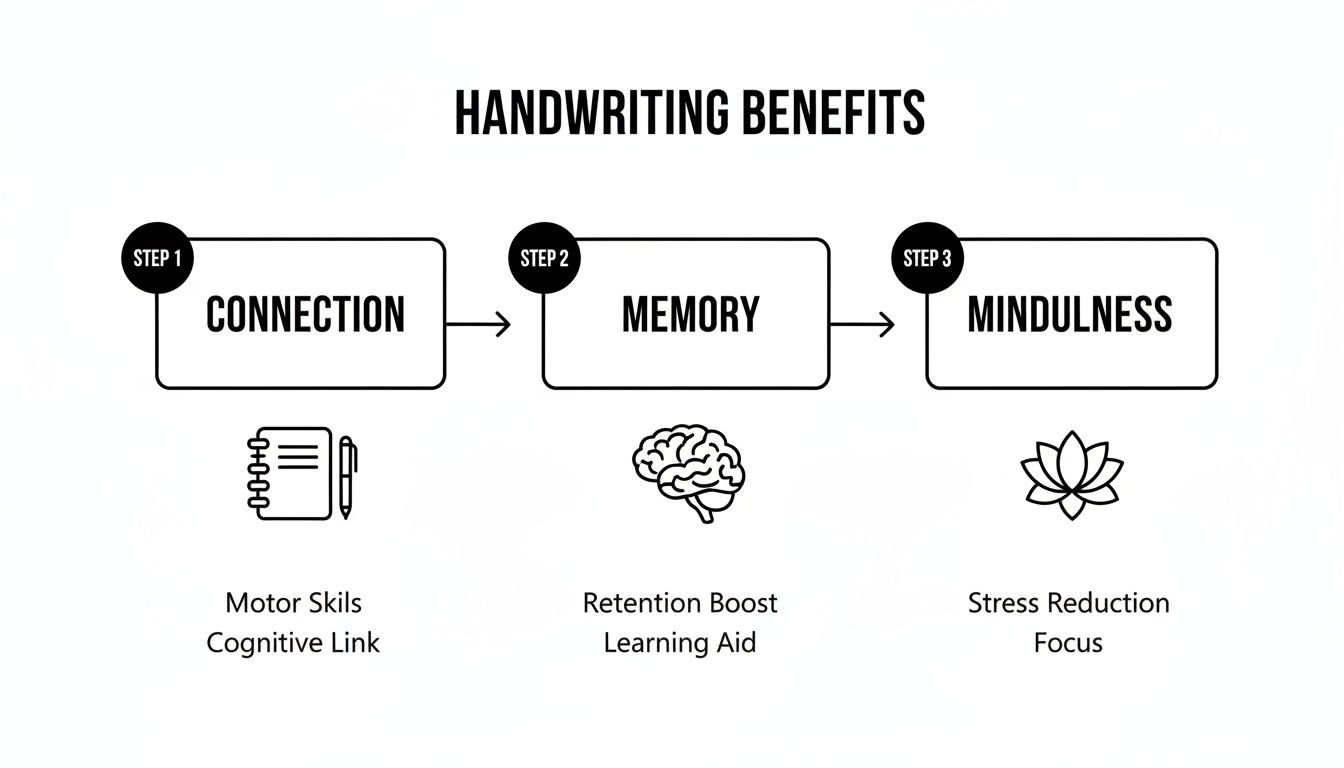
When your body is in a state of relaxed readiness, you create a stronger connection to your thoughts, improve your memory of what you write, and can even find a sense of mindfulness in the act itself.
Mastering a Relaxed Pen Grip
Many of us hold our pens with excessive force, a habit often acquired in childhood and never unlearned. This tense grip is a primary cause of discomfort and severely limits the delicate control needed for neat letterforms. The goal is to hold your pen with just enough pressure to guide it, letting the instrument do most of the work.
The tripod grip is widely considered the standard for its efficiency and relaxed nature.
- The pen should rest on the side of your middle finger.
- Your thumb and index finger gently hold it in place.
- Crucially, your hand and wrist should feel loose, with no tension.
A common mistake is attempting to draw letters using only finger movements. This is exhausting and leads to small, inconsistent writing. True fluency comes from engaging your whole arm, from the shoulder down, which allows for larger, more graceful movements that flow across the page.
It takes conscious effort to unlearn old habits. Make a point to regularly pause your practice and check in with your body. If your hand is tense, shake it out, stretch your fingers, and then begin again, focusing on maintaining a light, controlled grip. This physical awareness is the foundation for making your handwriting journey not just successful, but genuinely enjoyable.
How Quality Tools Elevate Your Penmanship
The instruments you choose are not mere accessories; they are active partners in your journey to better handwriting. The connection between your hand, your pen, and the paper sets the tone for every practice session. A well-crafted pen can transform a frustrating exercise into an effortless and enjoyable experience, making improvement feel less like work and more like a discovery.
A fine pen is designed to glide, not to be pushed. When you use a writing tool that delivers a smooth, consistent line with minimal effort, you naturally begin to relax your grip. This is a critical factor for improving handwriting for adults, as many common issues stem from the excessive pressure and hand fatigue built up over years of using subpar pens.
The objective is to let the instrument perform, freeing your hand to focus on forming elegant, fluid letters.
The Scriveiner Advantage in Your Hand
The engineering behind a superior pen directly influences your control and comfort. Scriveiner pens, for instance, are built around precision-engineered Schmidt writing systems from Germany. This ensures a remarkably smooth and reliable ink flow, whether you prefer the classic grace of a fountain pen or the consistent line of a rollerball.
This consistent performance means you can write with a much lighter touch. The pen becomes an extension of your hand rather than an object you must force into submission. You will find your movements become more graceful, your lines more confident, and your practice sessions can last longer without the familiar ache of a cramped hand.
A quality pen does more than just make marks on a page—it provides sensory feedback that guides your hand. The subtle resistance, the smooth glide, and the balanced weight all contribute to a more mindful and controlled writing experience.
How Writing Instruments Influence Your Practice
Choosing the right pen is a personal decision that shapes your daily practice. A fountain pen offers a classic, fluid experience that encourages a light touch, while a rollerball provides modern convenience with a similarly smooth feel. The table below compares how different premium pens can influence your handwriting journey.
| Pen Type | Writing Experience | Ideal For | Scriveiner Advantage |
|---|---|---|---|
| Fountain Pen | Elegant and fluid; requires minimal pressure. The nib adapts subtly to your writing angle over time. | Developing a light, relaxed grip and adding personal character to your script. | Precision-engineered Schmidt nibs and converters ensure a consistent, reliable ink flow, preventing skips and hard starts. |
| Rollerball Pen | Smooth and consistent, combining the ink flow of a fountain pen with the convenience of a ballpoint. | Everyday writing and practice sessions where you need reliable, effortless lines without the learning curve of a fountain pen. | Features the Schmidt 888 F refill, renowned for its incredibly smooth, skip-free performance that glides across the page. |
| Ballpoint Pen | Dependable and versatile; requires slightly more pressure but offers excellent control and longevity. | Quick notes, journaling, and writers who prefer more tactile feedback from the page. | Balanced weight distribution and ergonomic design reduce hand fatigue, even with the firmer pressure required for ballpoints. |
Ultimately, the best pen is one that feels right in your hand and encourages you to write more often. Whether you are drawn to the timeless appeal of a fountain pen or the modern reliability of a rollerball, a well-made instrument makes the path to better handwriting a genuine pleasure.
Why Your Choice of Paper Matters
Just as important as the pen is the surface on which you write. Switching to high-quality paper is a simple change that yields significant results. A smooth, non-absorbent surface prevents ink from "feathering" or bleeding, which keeps your letterforms crisp and well-defined.
This allows your pen to move across the page with minimal friction, enhancing that feeling of effortless flow so critical for developing a rhythmic, consistent script.
To explore further, you may visit our previous article where we explain why a pen could write differently on different types of paper.

The right paper complements your pen, creating a harmonious system where your ideas can be transcribed with clarity and elegance. For those particularly interested in the unique experience offered by a classic instrument, exploring our guide on writing with a fountain pen provides deeper insight into optimising your tools.
Developing Consistency Through Mindful Practice
Real, lasting improvement in your handwriting does not come from mindlessly filling pages. It is born from deliberate, focused effort. The idea is to build a practice centred on quality over quantity, fundamentally changing how you approach the page. This means slowing down, observing your work with a thoughtful eye, and making small, conscious adjustments.
This is where the real work of improving handwriting for adults begins. Approach it as a meditative process, one that retrains the delicate connection between your brain, your hand, and the pen. By focusing on how you write, not just what you write, you start to build the muscle memory needed for a fluid, consistent script.
Building a Foundation with Warm-Up Drills
Before forming a letter, you must prepare your hand. An athlete would not perform without stretching, and the same principle applies here. Simple warm-up drills awaken the small muscles in your fingers, hand, and arm, providing the control needed for elegant penmanship.
These are not random scribbles; they are exercises in rhythm and flow. Practising continuous loops, gentle waves, or a series of uniform ovals prepares your hand for the fundamental shapes that compose the entire alphabet. For a deeper exploration, consider dedicated fine motor activities for adults to properly condition these muscles.
The aim here is a light touch and consistent motion, letting your pen glide across the paper. A quality pen, like a Scriveiner, is a significant asset here. Its smooth ink flow naturally encourages a more relaxed grip, which reduces fatigue and strain.
Analysing and Refining Your Letterforms
Once your hand is warmed up, you can proceed to the core of the practice. This is the analytical phase, where you deconstruct your own writing to identify areas for improvement. Concentrate on the three pillars of a readable, consistent hand: size, spacing, and slant.
-
Size Consistency: Examine your lowercase letters like 'a', 'c', and 'e'. Are they all of a similar height? Do your ascenders ('b', 'd', 'h') reach a consistent point above the line, and do your descenders ('g', 'p', 'y') drop to a similar depth below it?
-
Spacing Consistency: Now, observe the gaps. Check the space between letters within a word, and then the space between the words themselves. The goal is uniformity, creating a line of text that appears balanced and is easy to read.
-
Slant Consistency: Do all your letters lean at roughly the same angle? An inconsistent slant is one of the most common reasons why handwriting may appear disorderly, even if the individual letters are well-formed.
It is essential to cultivate a critical but patient eye. Do not view mistakes as failures. Instead, treat them as data points that indicate exactly what to work on in your next session. This mindful observation is the true engine of progress.
This kind of targeted practice can help overcome challenges that, for many, began in childhood. In fact, UK research shows that handwriting difficulties affect a significant number of school pupils, often creating issues that persist into adulthood. Problems like poor coordination and slow writing speed are precisely what adults can address with focused practice and the right tools.
You might think it is impossible to fit this into a busy schedule, but it is more achievable than it seems. Even just fifteen minutes of focused effort each day can produce remarkable results.
Tackling Common Penmanship Hurdles
Even with the best intentions, most of us encounter ingrained handwriting habits that are frustratingly difficult to change. These are not failures; they are old patterns that require a new, targeted approach to unravel. Consider it a diagnostic process. By identifying what is holding you back, you can apply specific techniques to refine your script and finally develop that elegant, consistent hand you desire.
The path to improving handwriting for adults often means unlearning habits that have persisted since our school days. It is a common story. In the UK, it has been noted that many students struggle to meet handwriting standards, a challenge that can easily follow them into adult life. Disordered writing is not just an aesthetic issue—it can lead to professional setbacks. This is why putting in the conscious effort to overcome these common obstacles is so worthwhile. You can learn more about these UK handwriting standards and challenges if you're curious.

Finding Consistency in Spacing and Slant
Two of the most common issues that undermine otherwise decent penmanship are inconsistent spacing and an unstable slant. You could form each letter perfectly, but if the gaps between words are erratic or your letters tilt in multiple directions, the page can appear chaotic and become difficult to read.
-
For Spacing: Try using guided paper, like graph or dotted sheets, to retrain your eye. A useful rule of thumb is to consciously aim for a space between words that is about the width of a lowercase 'o'. This simple visual anchor can work wonders for consistency.
-
For Slant: Choose a direction—forward, backward, or vertical—and commit to it. Paper with pre-printed slant lines is an invaluable tool for this, as it helps build the muscle memory required to maintain a consistent angle across the page.
A frequent pitfall is gripping the pen too hard. This leads to hand fatigue and a heavy, laboured script. A quality writing instrument, such as a smoothly flowing Scriveiner pen, naturally encourages a lighter touch, making it much easier to maintain control and reduce strain over longer writing sessions.
Balancing Speed with Legibility
A common concern is that writing neatly takes too long for everyday tasks, such as taking notes in a meeting. The goal is not to write at a slow pace indefinitely. It is about building a solid foundation of correct form that holds up when you need to write more quickly.
To bridge that gap, start practising with timed writing exercises. Set a timer for two minutes and write as neatly as you can without sacrificing too much speed. When the timer stops, review what you wrote. What was the first element to degrade? Was it your letter formation, the spacing, or the slant?
Whatever the weakness, that becomes your focus for the next practice session. This targeted approach is how you gradually build the ability to write both quickly and clearly, turning your improved penmanship into a practical, sustainable skill.
Your Questions on Adult Handwriting
Embarking on the journey to better penmanship often brings up a few questions. We frequently see the same queries from adults looking to refine their script, so we have gathered our most practical answers here.
How Long Does It Realistically Take to Improve My Handwriting?
This is a frequent question, and the honest answer is that it varies. It depends entirely on how consistently and mindfully you practise.
With 15-20 minutes of daily, focused effort, most people start seeing a tangible difference in their letter formation and flow within a few weeks. However, to achieve a significant, lasting change in your natural script—especially when writing quickly—you should anticipate several months of sustained practice. The key is the quality of your focus. Concentrating on specific issues, like spacing or slant, yields results much faster than mindless repetition. Remember, you are retraining decades of muscle memory, so patience is as important as your pen.
Should I Learn Cursive or Just Improve My Print?
This is a personal choice that should align with your objectives. If your main goal is clear, neat, and legible handwriting for everyday notes and lists, then refining your existing print style is often the most direct path.
However, learning cursive has its own distinct advantages. Once mastered, it can be significantly faster and more fluid, as the pen lifts from the paper less often. Many people also find the aesthetic of connected letters deeply satisfying. For those looking to completely overwrite old, ingrained habits, learning a simplified cursive or italic hand can be an excellent way to build a new foundation from the ground up.
A quality writing instrument is a powerful catalyst for improvement. While not a magic solution, it elevates the physical act of writing from a mundane task to a genuine pleasure, which is crucial for maintaining long-term motivation.
Can a Good Pen Truly Make a Difference?
Absolutely. It is not merely about aesthetics. A pen with a smooth, consistent ink flow—like a well-made fountain or rollerball pen—requires far less pressure to write with. This directly combats the hand fatigue and cramping that can curtail your practice sessions. The superior tactile feedback also makes you more aware of the pen's movement across the page.
Using a premium instrument like a Scriveiner transforms the entire experience. Its effortless glide encourages a lighter grip and greater control, making it easier to form elegant, consistent letters. Put simply, it helps you enjoy the process of improvement.
What’s the Best Advice for Left-Handed Writers?
Left-handed writers face a unique set of challenges, most notably the risk of smudging wet ink. The first adjustment to try is tilting your paper clockwise by approximately 30-45 degrees.
Adopting an 'underwriter' grip, where your hand stays below the line of writing, is also highly effective at preventing smears. This contrasts with the more common 'hooked' overwriter grip that many left-handers develop. Using a fast-drying ink is almost essential. A pen that glides effortlessly is especially beneficial, as it minimises the 'pushing' motion required by left-handers and significantly reduces strain on the hand and wrist.
The journey to more elegant penmanship is a rewarding pursuit of precision and personal expression. With the right tools and a mindful approach, you can transform your handwriting into a source of pride and pleasure. Scriveiner is dedicated to providing beautifully crafted writing instruments that make this journey not just possible, but genuinely enjoyable.
Discover the difference a superior pen can make by exploring our collection at https://www.scriveiner.com.


Hinterlasse einen Kommentar
Diese Website ist durch hCaptcha geschützt und es gelten die allgemeinen Geschäftsbedingungen und Datenschutzbestimmungen von hCaptcha.