
Unlock Your Potential with Diary Writing: A Practical Guide
Writing in a diary is the timeless practice of recording your thoughts, feelings, and daily experiences. This simple act of putting pen to paper offers a powerful method for fostering mental clarity, documenting personal growth, and creating a lasting legacy of your inner life.
The Enduring Practice of Diary Writing
Keeping a diary is more than the mere cataloguing of daily events; it is a profound journey into self-discovery. For centuries, individuals have turned to the private pages of a journal as a trusted confidant—a space free from judgement where thoughts can unfold with complete honesty.
This enduring practice transforms the fleeting nature of our internal world into a tangible record, offering a unique perspective on our own evolution over time.
One of the most profound benefits of diary writing is its ability to cultivate self-awareness. It offers a dedicated space to reflect on your thoughts and emotions and learn how to be more self-aware. By externalising your inner monologue, you create an opportunity to observe your thoughts with greater objectivity.
A Sanctuary for Your Thoughts
A diary serves as a personal sanctuary. It's a place to process complex emotions, celebrate quiet victories, and navigate life's challenges.
The rhythmic motion of a quality pen gliding across paper—the simple, tactile experience of penmanship—can be a meditative act in itself. It encourages a slower, more deliberate form of reflection that is often lost in our fast-paced world.
This connection between hand, pen, and paper is integral to the experience. It is where the Scriveiner philosophy of accessible luxury and superior craftsmanship finds its purpose, elevating the daily ritual into an art form. You can learn more about this connection in our article on writing for clarity and how journaling nurtures the mind.
A diary is not merely a book, but a private stage for the theatre of the self. It is where you are the author, the character, and the audience, all at once.
A Tradition Passed Through Generations
The appeal of diary writing continues to resonate, even with younger generations. A UK survey from 2014 found that 21% of young people aged 8 to 18 wrote in a diary outside of school at least monthly.
The study noted a distinct gender difference, with nearly a third of girls engaging in the practice compared to just over 10% of boys. You can discover more insights from this youth writing habits survey.
This tradition highlights a fundamental human need to document our existence and understand our place within it. Your diary becomes a legacy—a collection of moments, ideas, and personal truths that map the unique journey of your life.
Choosing Your Tools for Reflection
The experience of writing in a diary is shaped profoundly by the tools you use. The connection between thought and page is bridged by your pen and journal, and choosing the right instruments can turn this daily practice from a simple task into a luxurious ritual.
This is not about indulgence; it is about honouring the importance of your own reflections. A beautiful, well-crafted pen and a high-quality journal send a clear signal to your mind: this time is sacred. It is a dedicated moment for introspection.
The Sensory Pleasure of Penmanship
The physical act of writing is a deeply sensory experience. A premium pen offers tactile feedback that a common writing instrument cannot match. The effortless glide of a quality nib across the page, the consistent flow of rich ink—it all creates a sense of effortless expression.
This sensation encourages a more deliberate and thoughtful pace. It slows you down, allowing your ideas to form more completely before they are committed to paper. This mindful engagement is at the heart of what makes diary writing so rewarding.
For a deeper look into how different instruments can enhance your practice, you might find our guide on the best pens for journaling particularly helpful.
Selecting Your Ideal Journal
Your journal is the vessel for your thoughts, so its qualities matter. The paper should be a welcoming surface for your chosen pen, preventing feathering or bleed-through and letting the ink's true colour shine. Consider paper weight, texture, and ruling to find what truly suits your style.
The binding and cover also play a role. A durable, lay-flat binding makes for a comfortable writing experience from the first page to the last. The cover, whether it's simple leather or decorated fabric, should be something you enjoy seeing and holding, inviting you to open it daily.
Your pen and journal are not just tools; they are your partners in the act of reflection. They should feel like a natural extension of your hand and a worthy keeper of your innermost thoughts.
The infographic below touches on the core reasons people are drawn to diary writing—legacy, clarity, and self-discovery—all of which are amplified by the use of quality tools.
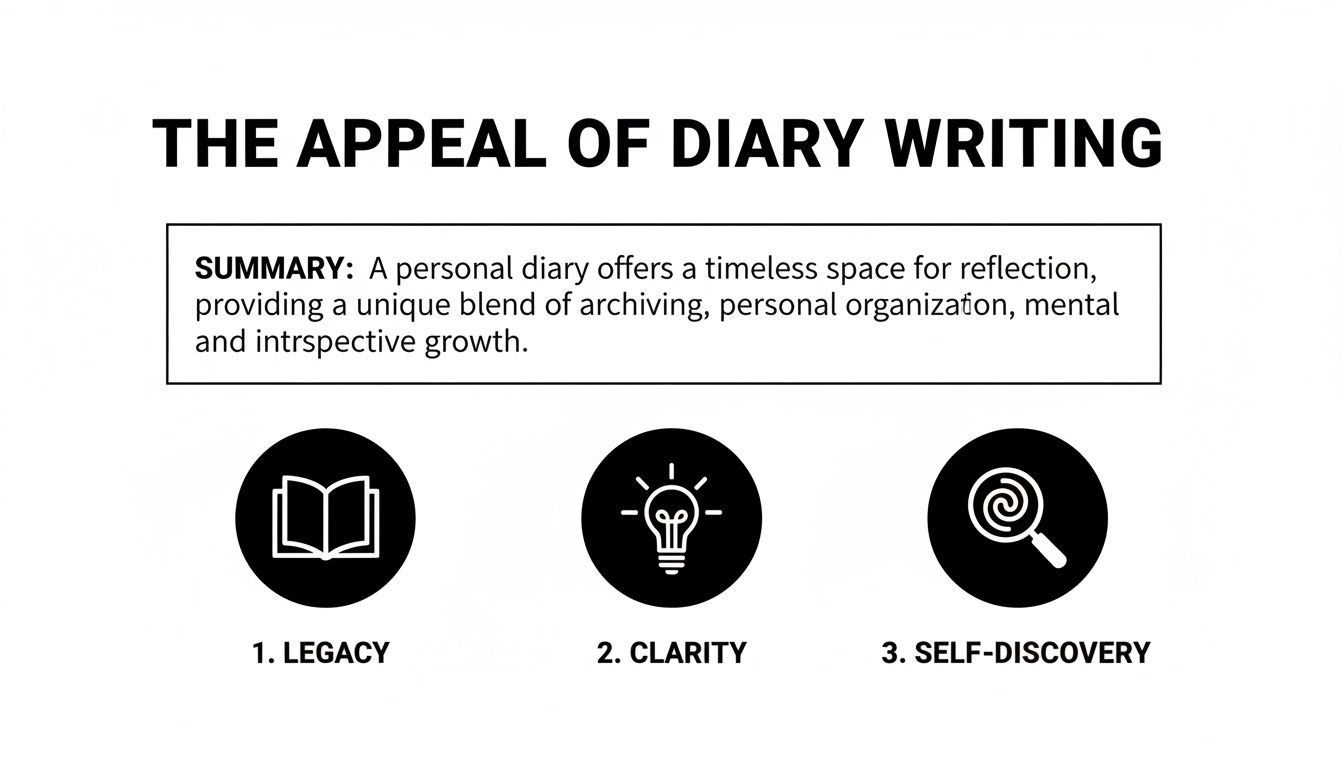
This visual reminds us that the practice is a multifaceted tool for personal growth, touching on everything from preserving memory and achieving mental focus to gaining a deeper understanding of ourselves.
The Personal Connection to Your Pen
Over time, you develop a unique connection with your primary writing instrument. It becomes more than just an object; it's a familiar companion on your journey of self-exploration. The weight of the pen in your hand, the way the nib has subtly adapted to your writing angle—these nuances create a bond.
Choosing a Scriveiner pen means selecting an instrument designed for this very purpose. Our range is crafted to suit a variety of personal preferences and writing styles.
Finding Your Ideal Scriveiner Pen for Diary Writing
| Pen Type | Writing Experience | Best Suited For |
|---|---|---|
| Fountain Pen | Classic, expressive, with a nuanced ink flow. The nib adapts to your personal writing angle over time. | Those who savour the ritual of writing and appreciate the character and shade of different inks. |
| Rollerball Pen | Smooth, consistent, and effortless. Combines the convenience of a ballpoint with the fluid ink of a fountain pen. | Daily writers who value a reliable and fluid line without the maintenance of a fountain pen. |
| Ballpoint Pen | Reliable, practical, and ready at a moment's notice. The oil-based ink is quick-drying and long-lasting. | Quick notes, bullet journaling, and anyone needing a robust, go-anywhere writing tool. |
Each Scriveiner is crafted to provide a superior writing experience, turning the simple act of recording your day into a moment of refined pleasure. This relationship with your tools enriches the entire process of writing in a diary, making it a practice you will cherish for years to come.
Cultivating a Consistent Writing Ritual
Transforming the idea of keeping a diary into a lasting practice is a matter of creating a personal ritual. This is not about forcing a rigid schedule, but about carving out a quiet, elegant space in your day that you genuinely look forward to—a small sanctuary for reflection.

The most effective rituals are often those attached to an existing habit, a technique known as ‘habit stacking’. By linking your diary time to something you already do every day, such as enjoying your morning coffee or the quiet moments before bed, you provide a natural cue. This removes the element of decision-making, allowing the practice to weave itself seamlessly into the rhythm of your life.
This simple association can be surprisingly powerful. Soon, the aroma of brewing tea or the stillness of the house becomes a signal, preparing your mind for the gentle act of introspection with your journal and a trusted pen.
Designing Your Reflective Space
Your surroundings have a profound effect on your state of mind. It is beneficial to designate a specific spot for writing, even if it is just a particular armchair or a corner of your desk. The key is that this space should feel calm, comfortable, and free from the usual distractions.
Over time, your mind will build a strong connection between this physical place and the act of reflection, making it easier to slip into a contemplative mood. You can enhance the atmosphere with small details that bring a sense of peace.
- Sensory Cues: A lit candle, a specific playlist of instrumental music, or the simple quiet of an early morning can all signal that it's time to write.
- Minimal Distractions: Place your phone out of reach and out of sight. This ensures your time is truly your own, dedicated only to the page in front of you.
- Ready Your Tools: Have your journal and your favourite Scriveiner pen waiting. The mere sight of these beautiful objects can feel like an invitation in itself.
By crafting a dedicated environment, you are not just setting a scene; you are sending a message to yourself that this time is valuable and this practice is worthy of intention and care.
Releasing the Pressure of Perfection
One of the greatest hurdles to consistency is the feeling that every entry must be profound or perfectly written. This pressure can be paralysing. The true purpose of a diary is to be a space for raw, unfiltered thought—an instrument for being truthful with yourself.
Allow your entries to be messy, incomplete, or mundane. Some days, you may fill pages with deep insights; on others, you might jot down a single sentence about your day. Both are equally valid. The act of simply showing up to the page is what matters most.
For those interested in the mechanics of building these kinds of lasting habits, our guide on how new habits stick offers a practical approach that can support your journey.
Remember that keeping a diary is an active practice. As you interpret your experiences on paper, you are not just recording a past version of yourself; you are actively shaping your present understanding. Embrace this fluid, imperfect process. The value is not in flawless prose, but in the honest, consistent act of showing up for yourself, pen in hand.
Finding Your Voice on the Blank Page
Staring at a blank page can feel like standing at the edge of a vast, silent landscape. A quiet pressure exists to fill it with something profound, but the beauty of a diary is that there is no right or wrong way to begin. Your journal is your own private space for exploration. Its only purpose is to serve you.
Instead of viewing your diary as a mere logbook for daily events, think of it as a versatile instrument for introspection. The style you use can shift with your mood, your needs, or the questions you are contemplating. Your voice on the page is not static; it is a living, breathing reflection of your inner world.
The benefits of finding this outlet are clear. A 2022 study by the National Literacy Trust in the UK found that young people who kept a diary showed a much greater enjoyment of writing. In fact, 51.1% of them enjoyed writing, compared to just 25.9% of those who didn't. A striking 69.2% used their diary specifically to spark creativity.
Exploring Different Styles of Introspection
To move beyond a simple chronicle of your day, you might experiment with more nuanced approaches. Each one offers a unique lens through which to view your thoughts and feelings, helping to uncover different layers of your psyche.
-
Gratitude Journaling: This is a deceptively simple yet powerful practice of writing down things you are thankful for. It has a way of shifting your perspective towards the positive, helping you notice small victories that might otherwise be overlooked.
-
Reflective Essays: Select a specific theme—a personal challenge, a recent success, or a recurring thought—and dedicate an entry to exploring it from all angles. This encourages a more structured, analytical form of self-examination.
-
Stream of Consciousness: This is perhaps the most freeing style of all. The only rule is to let your pen move without pausing, capturing thoughts as they arise without judgement. It is an excellent way to bypass your inner critic and tap into raw, authentic insights.
Ultimately, the consistent practice of writing in a diary helps to foster self-awareness and emotional well-being. The format you choose is far less important than the simple act of showing up for yourself on the page.
Finding a Format That Resonates
The key is to remain curious and flexible. You may find a bullet-journal format is perfect for organising your thoughts on busy weeks, while a more free-flowing, narrative style feels better for quiet weekends or periods of deep reflection. You do not have to commit to one method forever.
Allow your diary to be a dynamic tool. It can be a planner one day, a confidant the next, and a creative canvas the day after. Its true value lies in its versatility and its ability to meet you wherever you are.
Experimentation is part of the journey. Try different approaches, notice how they make you feel, and see which ones bring you the most valuable insights. Over time, you will cultivate a personal practice that not only feels natural but becomes an indispensable part of your life. That blank page is not an adversary; it is an invitation.
The Value of Your Written Legacy
A diary is much more than a simple record of your days. Consider it a living document, a personal journey captured in real-time. The quiet practice of putting pen to paper is an investment in your future self, creating an archive that offers a perspective and clarity you cannot find anywhere else. It is a celebration of the unique legacy you build with every single entry.

This personal masterpiece, preserved through the timeless combination of ink and paper, becomes your own private chronicle. Over the years, you can revisit past experiences, trace the patterns of your growth, and understand the person you used to be with a compassion that only distance can provide.
A Dialogue with Your Past Self
Re-reading old diary entries is a unique form of time travel. It forges a profound connection to your past self, offering a direct line to the thoughts, hopes, and anxieties that once felt all-consuming. You become both the author of your story and its most privileged reader.
This is where the real magic happens. In this dialogue across time, you see how challenges were overcome, how your perspective shifted, and how you evolved into the person you are today. It is a tangible record of your own resilience.
We appear to turn to this kind of reflection at key stages in our lives. A UK survey found that while 37% of 18-24 year olds keep a diary, the number dips in middle age before rising again to 35% among those 65 and older. It suggests we pick up the pen most often during our formative years and, later, when we have a lifetime to reflect upon. You can read more about these diary writing trends and findings.
Your diary is the only book in the world written about you, for you. It holds the unfiltered truth of your journey, making it one of the most precious heirlooms you could ever create.
Preserving Your Story in Ink
The physical act of writing is central to this legacy. Choosing a quality pen and journal ensures your words are not just recorded, but preserved with the care they deserve. Each entry, captured with smooth, flowing ink on archival paper, becomes a small monument to a moment in your life.
This is the true value of your written legacy: a beautifully crafted, deeply personal narrative that offers wisdom, comfort, and a lasting connection to your own history. It is a testament to a life thoughtfully lived and carefully recorded, one entry at a time.
Questions New Diarists Often Ask
Starting a diary feels like opening a door to a very private room. It is natural to have a few questions before you step inside. These are the kinds of concerns that arise time and again, from those just starting out to writers who have filled volumes.
One of the greatest hurdles is privacy. For a diary to be truly effective—for it to be a place of absolute honesty—you must feel safe. This is non-negotiable. A simple journal with a lock and key can work wonders, or even just finding a dedicated hiding spot. Creating that physical boundary provides the psychological space you need to write without reservation.
Finding Your Rhythm on the Page
How much should one write? This question hinders many people. The simple answer is: there are no rules. Some days, your thoughts will pour out and fill pages. Other days, a single, sharp sentence is all you need. That is perfectly acceptable.
The true power of a diary comes from the ritual, not the word count. A few honest lines written consistently hold more weight than a long essay written once a month. Let go of the pressure to perform. This makes the entire practice feel less like a chore and more like a conversation with yourself.
A diary isn't a performance for an audience. It's an exploration of the quiet, inner world that makes you who you are. Your perspective is the only one that matters here.
Another common hesitation is the feeling that life is not "interesting enough" to write about. This misunderstands the purpose of a diary. It is not a logbook of grand adventures; it is a tool for making sense of your own life. Your reflections on a conversation, your thoughts on a book, or how you are navigating a small, personal challenge—that is the real substance. It is about processing your experience, and that is always a worthy subject.
The Writing Itself
Finally, people often ask if they should edit their entries. My advice is to write freely and resist the urge to correct yourself. Your diary is a sanctuary for raw, unfiltered thought. The goal is to capture your voice as it is in that moment, not to polish it for someone else.
Editing introduces a layer of self-consciousness that can obstruct the natural flow of your thoughts and feelings. Allow your entries to be messy, imperfect, and real. Honesty matters far more than beautiful prose. When you prioritise that spontaneous expression, you create a far more valuable record of your inner life, turning the act of writing in a diary into a genuine tool for discovery.
Elevate your reflective practice with an instrument designed for the thoughtful writer. Discover the elegance and precision of a Scriveiner pen and transform your diary into a legacy of beautiful introspection. Explore our collection today.

Hinterlasse einen Kommentar
Diese Website ist durch hCaptcha geschützt und es gelten die allgemeinen Geschäftsbedingungen und Datenschutzbestimmungen von hCaptcha.